

Meta has confirmed its VR Glasses for a Spring 2027 release, a lighter, more comfortable VR headset built for review sessions rather than all-day wear. The weight and bulk of a full headset shell keep some reviewers from staying in a model as long as a coordination meeting demands. A slimmer VR form factor won't fix every barrier to BIM adoption on its own, but it lowers the bar for who sits down to review a model and for how long they stay in it. Here's what that could mean for how your team runs coordination.
TLDR:
- Meta VR Glasses are lighter and less bulky than a full headset shell, making them easier to put on and stay in through a review session.
- VR in construction today lives in pre-construction: design sign-offs, constructability reviews, and coordination meetings.
- A lighter VR headset lowers the barrier to joining a scheduled BIM review, even for foremen and facilities staff who balk at a bulkier device.
- Full-color passthrough AR/MR looks promising based on reported specs, but Meta has not confirmed that capability before the product ships, and OSHA PPE rules remain a barrier to active-site use regardless.
- Resolve runs full federated BIM on the Quest today, with two-way issue sync to ACC and Procore across VR, web, and iPad.
What Meta VR Glasses Are (and How They Differ from the Quest Line)
Meta has announced Meta VR Glasses, a new category set to ship in Spring 2027, sitting alongside the Quest line rather than replacing it, a lineup that continues to evolve as rumors swirl around a possible Meta Quest 4. They use the same VR rendering approach as the Quest: the outside world disappears and the digital environment takes its place.
What changes is the shell. A slim frame replaces the full headset enclosure, cutting weight and bulk for professional and extended use. Reported specs point to front-facing cameras capable of full-color video passthrough and a micro-OLED display around 2412 x 2288 pixels per eye, hardware that could support mixed reality overlays layered on the real world. None of that is confirmed until the product ships. Worth separating out: the Ray-Ban Meta smart glasses are a different, unrelated consumer product with no spatial computing or BIM capability.
Quest headsets and Meta VR Glasses share the same core premise: you are inside a virtual space, not looking through it to the real one. Glasses just make that session lighter to wear, which opens the door to longer stretches, a meeting, a coordination walk through a federated model, or extended use without the fatigue a full shell brings on.
That distinction shapes how each device fits into a work context. A bulkier Quest headset still works fine for a focused review session. A lighter glasses form factor makes it easier to stay in a model longer, which changes how long a session can run and who is willing to sit through one.
The Form Factor Shift and Why It Matters for Jobsites
Scheduled review sessions in pre-construction are where VR already lives, and that is exactly where a lighter form factor helps. The Quest 3 works well for a focused design sign-off, but putting it on still carries a certain weight, literally and socially, for participants who do not use VR regularly. A full enclosed shell signals a commitment. A slim frame does not.
Glasses change the ergonomics of a scheduled review. A slim frame is faster to put on before a meeting and lighter to wear through a walkthrough, so a session can run longer before someone asks to step out. That changes who agrees to sit through a design sign-off or a coordination meeting in the first place.
The practical implication for pre-construction coordination is real. A foreman who would never commit to a full headset session might stay through an entire constructability review in a lighter device. The barrier has always been the weight and the commitment the hardware implies, not the content of the model itself.
| Meta VR Glasses (projected*) | Quest Headset | |
|---|---|---|
| Form factor | Slim eyewear frame | Full enclosed shell |
| Hard hat compatible | Lighter; still requires PPE removal for safety | No, requires PPE removal |
| Visual mode | Full VR immersion; AR/MR via passthrough reported but actual use undetermined until product release | Full VR immersion |
| Session type | Continuous wear, opportunistic use | Scheduled, session-based review |
| Primary users | Foremen, facilities staff, owner-side reps, VDC engineers, trade partners, GC teams | VDC engineers, trade partners, GC teams |
| Best BIM use case | Pre-construction review, design sign-offs, coordination meetings | Pre-construction review, design sign-offs, coordination meetings |
| Processing headroom | Connected through processing puck to run BIM locally | High; runs full federated BIM locally (Wellington Engine) |
* No BIM-capable glasses product from Meta ships today. The Meta VR Glasses column reflects projected characteristics of the glasses form factor based on current hardware trends, not confirmed specs of a shipping product.
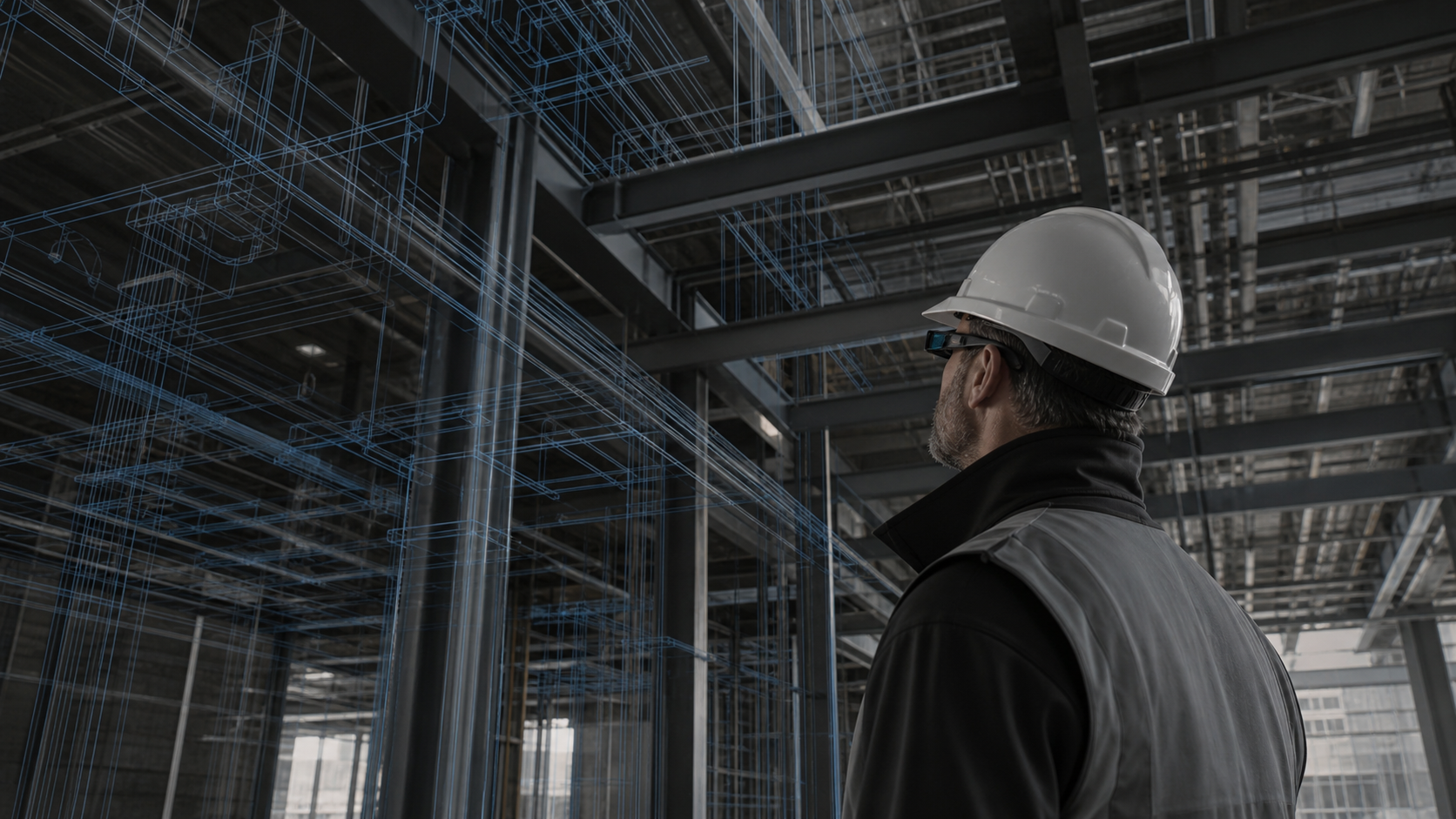
Wearability alone does not move coordination forward, though. The model still needs to load, the content still needs to be readable at a glance, and the hardware still needs to survive a site environment. Form factor is one constraint among several.
Where VR Already Fits in BIM Coordination Today
BIM virtual reality has a clear home today in construction coordination: pre-construction. Teams put on a Quest headset during scheduled review sessions to walk a federated BIM model before anything gets built.
The three contexts where this shows up most are design sign-offs, constructability reviews, and coordination meetings.
- In a design sign-off, facilities staff or an owner's team steps through spaces they will eventually operate, catching access and clearance issues that 2D drawings never surface.
- In a constructability review, a superintendent treats the model like a site walk, flagging sequencing and installation problems while there is still time to fix them.
- In coordination sessions, trade partners and the GC team move through shared model space together, resolving conflicts that clash detection alone cannot catch.
What makes headsets work here is spatial scale and shared presence. Standing inside a model at full human scale registers things a screen never does: a panel that is technically clash-free but physically unreachable, a corridor that reads as compliant in plan but feels impassable at size. Multiple participants can be in the same model at once, from VR, web, or iPad, so decisions happen in the room instead of across weeks of screenshots and emails.
The limitation is that this is session-based. Teams schedule the review, put on headsets, work through the model, and then take them off. The headset is a focused tool, not a persistent one.
Hardware Constraints That Have Slowed VR Adoption in Construction
Four friction points come up repeatedly when construction teams try to push VR beyond the VDC team.
- Bulk and comfort: a headset that works fine for a 30-minute review session gets heavy fast, and longer walkthroughs with less technical participants often hit a wall before the model review does.
- Hard hat compatibility: removing PPE to put on a headset is a real barrier, not a theoretical one.
- Hygiene: shared headsets passed between a superintendent and a trade partner on a live jobsite require cleaning between uses, which discourages spontaneous use.
- Onboarding: a foreman skeptical that his feedback will matter is not going to invest time learning controller inputs. The device has to feel like less of a commitment.
Battery life adds another layer. Quest headsets run roughly two to three hours on a charge, which is fine for a scheduled design review but creates awkward breaks when sessions run long.
These barriers explain why VR adoption in construction has largely stayed inside the VDC function and never reached the field staff and owner-side stakeholders who have the most to contribute to early coordination.
What Glasses-Style Hardware Could Unlock for BIM Review
The barriers covered in the previous section point to a specific gap: the people with the most useful feedback, foremen, facilities staff, owner-side operators, are also the least likely to agree to a full headset session.
Glasses-style hardware changes that calculus by lowering the cost of showing up.
- A facilities manager invited to a design sign-off is more likely to stay for the full review if the device is a light frame instead of a bulky headset strapped over her head.
- A foreman asked to join a constructability review might sit through the session without the self-consciousness that comes with a full VR rig in a room of engineers.
- An owner's rep pulled into a coordination meeting could follow along comfortably for the length of the session instead of asking to swap out early.
None of these are blocked by software. They are blocked by how intimidating the hardware feels to someone who does not use it often. Glasses lower that barrier enough that more people stay in the room for the full review.
The bigger unlock may be in onboarding reluctant participants. A foreman who resists a scheduled VR session with a full headset might agree to the same review if the device feels less like a commitment. That changes who shows up to the review and whose input gets heard before construction starts.
VR Mode and What the Lighter Form Factor Changes
Meta VR Glasses are a VR device. The outside world disappears and the digital model takes its place, the same as a Quest headset. What the lighter form factor changes is who is willing to put one on for a scheduled review and how long they stay in it. That is the near-term story for construction coordination.
For pre-construction review, the use case stays exactly what it is today on the Quest. A VDC team schedules a session, loads a federated model, and walks through it with trade partners, the GC team, or the owner's rep. A lighter device lowers the friction of that session for participants who are not regular headset users. Facilities staff who would have skipped the session or asked to swap out early can stay in longer. The model review gets better input.
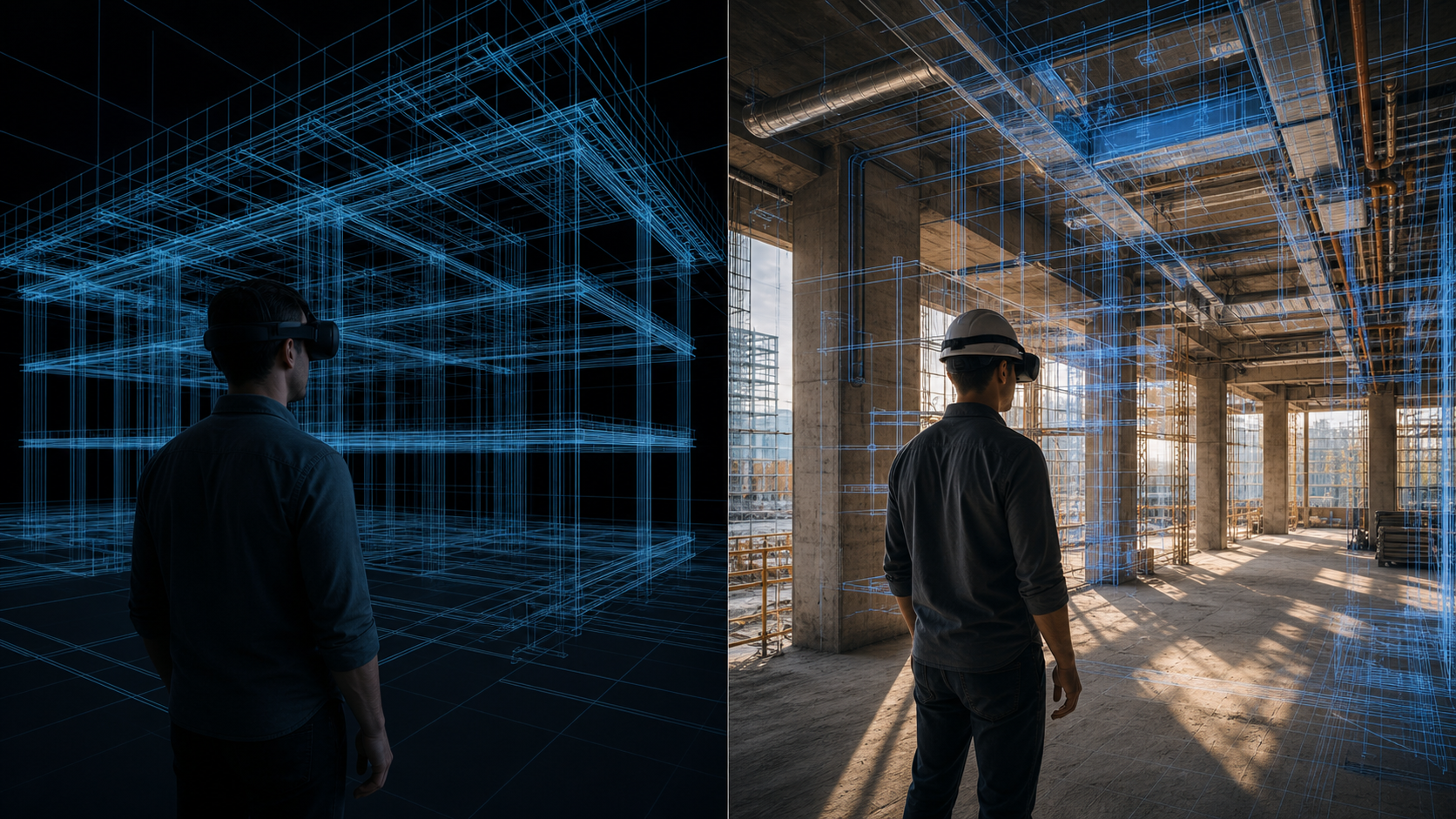
The Meta VR Glasses' reported specs, full-color passthrough cameras and an open-periphery design, suggest AR and MR capability is part of the vision, but those features remain unconfirmed before the product ships in Spring 2027.
Even if they land as described, OSHA PPE requirements mean workers cannot swap certified safety glasses for a glasses-form device on active sites without formal substitution approval, a path most jobsites have not cleared. The near-term value is lighter, more accessible VR review sessions held before construction begins, with the same full-immersion model experience teams already run on the Quest.
Processing Power and Model Fidelity: The Core Technical Question
Slim frames create an obvious question: what is doing the computation?
Quest headsets run Resolve's Wellington Engine locally, handling full federated models on standalone hardware through virtualized geometry and custom occlusion culling. No tethered PC, no downsized mockup. Glasses present a harder problem: a lightweight frame has less thermal headroom, a smaller battery, and far less processing headroom relative to a headset.
A federated model from a large-scale commercial or complex hospital build routinely reaches tens of millions of polygons across a dozen discipline files, a load Resolve's Wellington Engine handles on standalone Quest hardware. Getting that to render smoothly on a device that also has to survive a full site day is a different engineering challenge than what glasses-form hardware has solved.
The likely paths are cloud streaming and on-device offloading. Both introduce latency and connectivity dependencies. On an active jobsite, reliable high-bandwidth connectivity is not guaranteed, and a model review that freezes mid-walk is worse than no review at all.
Display Fidelity on Small Optics
Fidelity matters here in a way it does not for gaming or social apps. BIM geometry is not cinematic 3D. Equipment clearances, pipe routing, and structural interfaces need to read clearly at a glance. On a small waveguide display, display constraints are tighter. Current waveguide optics used in AR glasses typically deliver around 30 to 35 pixels per degree. The Quest 3 panel runs closer to 25 pixels per degree across a much wider field of view, but that wider field of view is what lets users read BIM geometry in spatial context, not through a narrow window. For coordination use, the Quest 3's advantage is not raw pixel density but how much model you can see at once. A narrow-FOV waveguide that forces users to pan through a pipe run to follow its routing loses the spatial legibility that makes model review useful in the first place. Whether glasses-form optics can widen that field of view enough to present BIM geometry with the spatial clarity needed to catch a real coordination issue remains an open question.
AI-Assisted Model Navigation and Its Role in New Hardware Contexts
Glasses-style hardware only helps if the person wearing it can find what they need. AI model navigation is a prerequisite, not a feature.
On a Quest headset, a VDC engineer typically drives the session. That works in a scheduled review with a moderator present. It breaks down when a superintendent is walking a floor alone, or when an owner's rep wants to check something during a site visit without pulling anyone off their work.
Resolve's AI Spatial Assist lets users query the model in plain language: find a piece of equipment, jump to a system, surface a property. For a non-specialist wearing glasses on a live site, that replaces the need for a BIM expert in the room.
The connection to glasses form factor, one of the many XR acronyms in construction worth untangling, is direct. A superintendent is not going to scroll through a model tree on a small overlay display. Voice or gesture queries against a model that already understands spatial context fit the hardware. Controller-based navigation designed for a headset session does not translate to a quick glance while walking.
Whether the hardware can support that reliably on site depends on connectivity and processing headroom, both still open questions. The AI layer is what makes a model accessible to a foreman without a specialist in the room.
Integration with Existing BIM Workflows: What to Watch
New hardware means nothing if it sits outside the workflow, and expanding BIM access for field teams depends on that integration. A glasses-form BIM overlay that cannot push issues to ACC or Procore is a novelty, not a coordination tool.
The baseline for construction adoption is straightforward: the device needs to connect to where the model lives and where issues get tracked. For most teams, that means Autodesk ACC or BIM 360 for model management, Procore for field issue tracking, and possibly Revizto for coordination issue logs. Any hardware that requires a separate file import or a disconnected annotation workflow adds friction instead of removing it.
Cross-device collaboration is the other non-negotiable. On a live jobsite, not everyone is wearing the same device. A superintendent in glasses, a trade partner on a web browser, and a VDC engineer on an iPad all need to see the same model state at the same time. That requires a backend that handles multi-user presence across form factors.
Issue sync is where adoption tends to break down. If an annotation created during a glasses walkthrough does not flow back into the project's issue log, it disappears. Two-way sync, the kind that maps status changes between the review tool and ACC or Procore, keeps field observations from becoming orphaned notes. New hardware inherits that requirement regardless of form factor.
How Resolve Uses the Meta Quest Ecosystem for Wireless BIM Review Today
Resolve has been building inside the Meta ecosystem since the Oculus Go era, part of a longer push toward wireless VR on construction sites. When the Quest line arrived, Resolve was among the first to put a BIM application on the store. The work since has focused on making full federated models usable on standalone wireless hardware.
The Wellington Engine is what makes that possible. Written in C++ and compiled to native graphics targets like Vulkan and Metal, it runs virtualized geometry and custom occlusion culling on the Quest without a tethered PC. It handles that geometry load on standalone wireless hardware, with no tethered PC, no downsized mockups, and no Navisworks container workarounds.
That foundation has supported hundreds of large-scale construction projects delivered by teams using Resolve for pre-construction coordination. The workflows already exist: federated BIM linked from ACC or Procore, multi-user sessions across VR, web, and iPad, and two-way issue sync that keeps VR annotations from becoming orphaned notes.
When glasses-form Meta hardware matures to the point where it can handle BIM geometry reliably on a jobsite, the integration layer, the model connections, the issue workflows, and the cross-device presence will already be there. The hardware changes the form factor. The ecosystem is already built.
Meta VR Glasses and BIM: What Comes Next
Form factor has always been the quiet barrier between the VDC team and the field. Glasses-style hardware does not solve every constraint, but it gets closer to removing the interruption that keeps superintendents and facilities staff out of the coordination loop. Your team does not need to wait for glasses hardware to mature to start building that habit. See how Resolve handles BIM review, and the ecosystem will be ready when the hardware catches up.
FAQ
What should VDC managers know about Meta VR Glasses before considering them for BIM review workflows?
Meta VR Glasses, announced and expected to ship in spring 2027, are a lighter, more compact VR device built for professional use, not a pair of AR frames. They still enclose the field of view like a headset, but the reduced bulk matters for VDC managers because it changes who can participate in model review, and on what terms. Reported specs include full-color video passthrough that could enable mixed reality overlays, but these capabilities remain unconfirmed until the product ships. Foremen, facilities staff, and owner-side operators who would not schedule a bulky headset session might engage with a lighter device the same way they engage with a phone: quickly, on their own terms.
How do Meta VR Glasses differ from the Quest 3 for construction BIM coordination?
Both devices deliver full VR immersion. The difference is form factor and weight, not visual mode. The Quest 3 is a full-immersion headset designed for scheduled, session-based review; it still requires removing PPE on an active site. Meta VR Glasses are a lighter, more compact version of that same immersive experience, designed to be less of a burden to put on for a quick session. For BIM coordination, that difference lowers the bar for who picks up the device, not what they see once they do.
What construction tech tools integrate with Procore and Autodesk ACC for real-time BIM model review across VR, web, and iPad?
Resolve connects directly to Autodesk ACC, BIM 360, and Procore, syncing models and issues so that annotations created during a VR or glasses-form walkthrough flow back into the project's issue log and not into orphaned notes no one tracks. Multi-user presence across VR headsets, web browsers, and iPad means a superintendent in the field and a VDC engineer on a laptop can work in the same model state at the same time.
What are the core technical barriers to running full federated BIM on lighter VR hardware?
Processing headroom and connectivity are the two hard constraints. Federated models from hyperscale data centers and complex hospital builds routinely reach tens of millions of polygons across a dozen discipline files. Quest headsets handle that load through Resolve's Wellington Engine running virtualized geometry and custom occlusion culling locally. A lighter, more compact VR device has less thermal capacity and a smaller battery, so the likely paths are cloud streaming or offloaded compute, both of which introduce latency. On an active jobsite, reliable high-bandwidth connectivity is not guaranteed, and a model review that freezes mid-walk creates more friction than no review at all.
It's time to build in months, not years.