


Meta expects its VR glasses to beat current Quest hardware. The device has not shipped. Nobody has tested it on a BIM workload. A spring 2027 launch sounds far off until you factor in a project awarded this quarter that could still be in active VDC coordination when the glasses ship. What follows is informed speculation plus a checklist of what to verify before that timeline forces your procurement decision.
TLDR:
- Meta VR glasses are an expected upgrade but remain unreleased and untested, and reported cloud or companion-device processing leaves BIM performance at scale unconfirmed, so treat every claim here as speculation until they ship.
- Frame drops below 72 fps cause motion sickness; test your actual federated model before any hardware rollout.
- Enterprise IT procurement at ENR Top 100 contractors runs three to six months, so start the conversation now.
- MDM support, SSO, and fleet management tools for the glasses have not been confirmed for the spring 2027 launch.
- Resolve runs full federated models on standalone Quest headsets without a PC tether or downsized files.
What Meta VR Glasses Actually Are
Meta's VR glasses are a distinct product category from the Quest line. Where Quest headsets are self-contained computing devices worn like a helmet, the glasses form factor targets something closer to everyday eyewear: lighter, slimmer, and designed for longer wear. Meta announced the product at Connect 2026 with a spring 2027 target window, alongside ongoing speculation about the next Meta Quest headset.
The key distinction from Quest 3 is form factor and computing architecture, based on what Meta has announced so far. Processing is reported to be handled either by a companion device or offloaded to the cloud, which would change the performance equation entirely. Display approach is also expected to differ, with waveguide optics reported in place of the pancake lenses in current Quest hardware. Meta has not shipped the hardware, no independent testing exists, and these details come from announcement materials that could change before launch.
For any team assessing the device, that architecture gap is where the real questions start.
Why VDC Teams Are Paying Attention
Quest headsets are the dominant device for immersive BIM review on complex industrial projects. Meta's VR glasses are expected to be a step up from current Quest hardware, but they have not shipped and have not been tested against real BIM workloads. That gap lands as a procurement question. Headsets get bought in batches. Refresh cycles run 18 to 36 months. A team building out its VR coordination program today has to decide whether to commit to current Quest hardware or wait on a promise rather than a product, a question tied directly to Meta VR glasses announcement for construction.
Spring 2027 is close enough to matter. A data center project awarded this quarter could still be in active VDC coordination when the glasses ship. That is the window where hardware choices get made and where the wrong call creates friction mid-project.
The Standalone Question: Why It Matters More Than Weight
For construction workflows, the standalone question cuts deeper than weight, display quality, or price.
A tethered headset requires a PC within cable range. On a congested mechanical floor or during an active data center walkthrough, that cable limits where you can go, who can participate, and how fast a session moves. That is why wireless VR wins on construction sites. Revizto's own VR feature requires a PC tether, which is part of why serious VR users go elsewhere.
Meta Quest headsets are fully standalone. The chip, memory, and graphics processing all live in the device.
The Meta VR glasses are reported to use a different architecture, offloading processing to a companion device or the cloud. What that means for enterprise BIM workloads at full federated model scale, the kind of scale the Wellington Engine was built to handle, has not been confirmed by Meta with any specificity. Latency, frame stability under load, and offline capability in poor-connectivity environments remain open speculation since no one outside Meta has tested the device. For a hyperscale data center coordination session with 20 stakeholders and a multi-discipline federated model, those are not minor details.
The glasses are expected to be an upgrade in form factor, but they remain unreleased and unproven. Until they ship with published specs and third-party testing under real BIM load conditions, the standalone advantage of current Quest hardware stays the safer bet for active project deployments.
Passthrough and Mixed Reality Readiness for Field Walkthroughs
Color passthrough is a baseline requirement for construction work. When a superintendent walks a mechanical room mid-construction, overlaying the BIM model onto what is physically in front of them lets them compare design intent against installed conditions without swapping between a headset and a printed drawing.
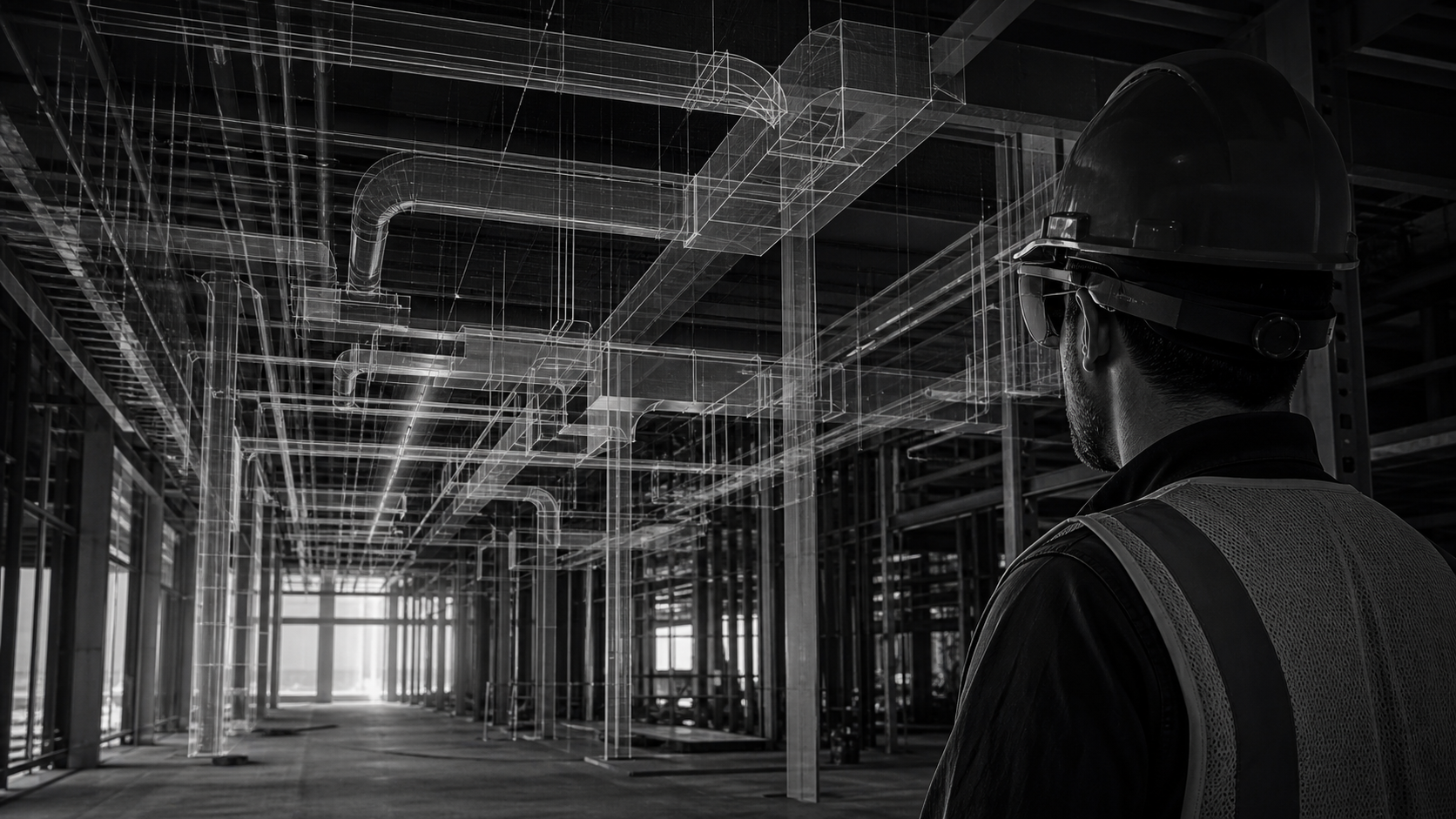
Resolve supports passthrough mixed reality on Quest 3 for design and construction BIM review, including synced AR walkthroughs for co-located teams. A team can anchor the model to a physical space and walk it together, flagging deviations before they compound.
The Meta VR glasses offer an architecturally different passthrough approach, at least on paper. The form factor is expected to bring a wider field of view and a thinner optical stack, but that remains speculation until the device ships and someone tests it on site. Construction sites are not controlled environments. Lighting varies widely: overexposed weld areas, dim pipe chases, harsh sodium vapor fixtures. How waveguide optics in the glasses handle that range under real site lighting has not been detailed by Meta for enterprise use cases.
A washed-out or laggy overlay makes spatial comparison unreliable, and an unreliable overlay is worse than none.
Computing Power and Federated Model Performance
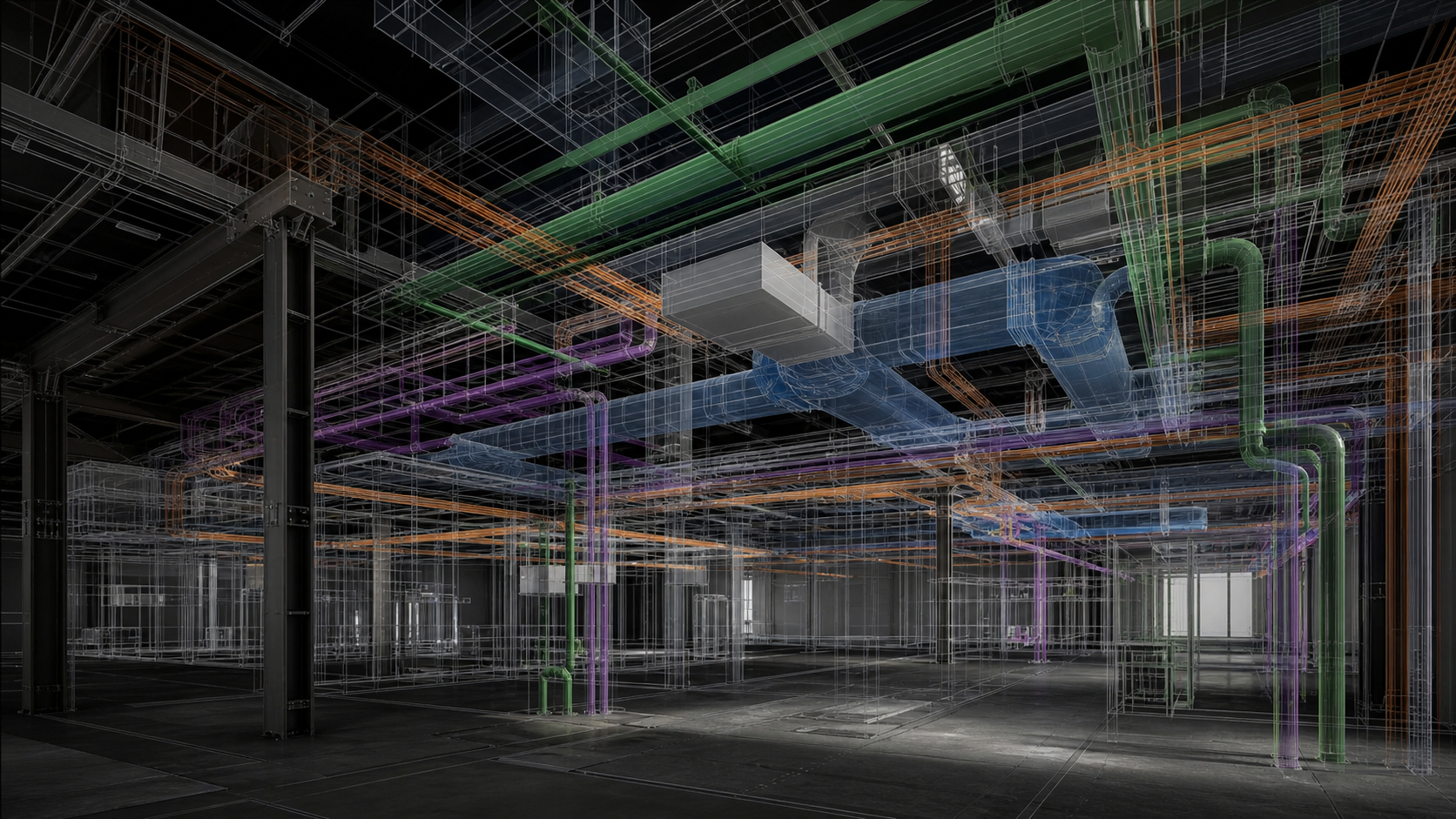
Federated BIM models from hyperscale data centers or pharma facilities are not light files. Combine structural, mechanical, electrical, and plumbing disciplines from multiple trade partners and you are easily looking at tens of millions of polygons in a single session. That geometry has to render at a stable frame rate, in real time, across a session running 60 to 90 minutes with multiple participants.
| Evaluation Criteria | Meta Quest 3 | Meta VR Glasses (Expected Spring 2027, Unreleased) |
|---|---|---|
| Processing architecture | Fully standalone (on-device chip, memory, GPU) | Reported: offloaded to companion device or cloud |
| PC tether required | No | Not expected, unconfirmed |
| Color passthrough / mixed reality | Supported (pancake lenses) | Waveguide optics; field performance on sites unconfirmed |
| Frame stability under load | Tested on multi-discipline models | Untested; no hardware in the field yet |
| Enterprise MDM / SSO support | Confirmed (Meta Horizon Managed Services, Azure Entra ID) | Unconfirmed for launch |
| Offline / poor-connectivity use | Supported | Unconfirmed; cloud dependency is a risk |
Frame drops are not a cosmetic issue, and they trace back to the same causes of large BIM model lag that affect any federated session. Meta's developer guidance sets a 72 FPS minimum for Quest, and below roughly that rate, motion sickness risk climbs fast. One bad session can set back VR adoption on a project team faster than any hardware cost concern.
The specs Meta announced at Connect 2026 are all anyone has right now: reported figures covered battery life under light use, display brightness, and comfort for daily wear. No one outside Meta has tested the glasses on a federated BIM model. What happens to frame stability when a 40-discipline model is loaded with six participants active, 30 minutes into a session, is speculation until someone runs that test.
This test plan applies once the hardware ships and a unit can be borrowed or bought. Load your actual federated model, not a sample file. Run a full-length session with your real participant count, and check frame stability late in the session, including well past the opening minutes. Until a unit is in hand, assume nothing about how it performs.
Device Comfort and Fatigue in Extended Coordination Sessions
Extended coordination sessions on complex mechanical floors can run well past an hour. At that duration, headset comfort stops being a preference and becomes a session completion problem.
For teams with little prior VR experience, discomfort is the most common reason sessions get cut short. One bad session sticks. The team remembers the headache, not the coordination value.
Weight distribution matters more than total weight. A lighter device that pulls forward degrades faster than a heavier, well-balanced one. Meta promises a lightweight VR glasses form factor, and lighter than Quest would be a real upgrade for long coordination sessions. But the glasses have not shipped. No one has worn a pair through a 45-minute enterprise session yet, so comfort claims stay speculation until that testing happens. Fit and balance remain unknowns for VDC deployments.
IT and Enterprise Deployment Readiness
Enterprise IT approval runs longer than most VDC teams expect. At large general contractors, procurement cycles for new hardware can easily run three to six months from initial request to deployment approval. A device shipping in spring 2027 needs an IT conversation starting now.
The checklist is predictable: MDM compatibility, SSO support, security review, network access approvals, and device fleet management. Resolve supports Meta Horizon Managed Services for Quest fleet management and Azure Entra ID SSO because enterprise deployment without those integrations stalls at the IT desk.
The Meta VR glasses are planned as a consumer launch. Because the product has not shipped yet, whether enterprise MDM support, SSO, and fleet management tools will be available at launch remains unconfirmed. Consumer hardware without MDM support means IT cannot remotely manage, update, or wipe devices across a project team. If your security review requires a vendor questionnaire, penetration test documentation, and legal sign-off, that process does not compress because a product launch looks exciting.
Fitting New Hardware Into Your BIM Workflow
A new headset is a workflow audit. Not a hardware swap.
The questions that matter for a VDC team are specific: Does the new device run the same BIM review software already connected to ACC, BIM 360, Procore BIM models in VR, and Revizto? Do issue sync workflows still push annotations back to the correct platforms? Can web and iPad participants still join the same session without a headset?
Each question represents a real dependency. If a new device requires a different app, that app needs its own integration setup, IT approval, and user onboarding before a single session runs. If issue sync breaks, annotations logged in VR stop reaching the coordination team's live issue log.
The cross-device session structure matters too. On most active project teams, the VR user is one participant; the rest join on web or iPad. If the host device changes apps, the web viewer link, follow behavior, and annotation layer can all shift with it, which is exactly the kind of risk a VDC manager's hardware checklist should catch early.
Run the audit before committing to any hardware. Confirm app availability, integration continuity, and session behavior against your actual project stack before the device decision is made.
What Should Drive Hardware Decisions
Hardware specs make for compelling announcements. They rarely produce compelling coordination outcomes.
The question worth asking before any device evaluation is whether the hardware your team is considering has been tested on production-scale models, with real participant counts, feeding issues back into the tools your coordination team already uses. Frame rate on a sample file says nothing about session stability on a 40-discipline federated model in month three of a data center VDC program.
The other criteria are equally unglamorous:
- Trade partners and owners cannot be expected to install apps or manage accounts just to join a review session. Web access from a browser link, with no download required, is what gets non-VR participants into the model consistently.
- If issue annotations logged during a VR session stop syncing to ACC, Procore, or Revizto, the coordination value disappears regardless of how good the headset felt.
Hardware-led adoption cycles are a real failure mode, the same pattern that played out with Apple Vision Pro in design and construction. A team buys new devices because a product launch looks relevant, software readiness gets assumed without being confirmed, and the first project deployment surfaces the gaps. A spring 2027 announcement does not compress the validation work new hardware requires before live deployment.
Buy for the workflow. Validate on your actual models, your actual software stack, and your actual team before committing.
Resolve's Approach to Hardware on Industrial Projects
Resolve's Wellington Engine is why current Quest deployments work at the scale industrial projects demand. Written in C++ and compiled to native graphics targets including Vulkan and WebGPU, it uses virtualized geometry and custom occlusion culling to run full federated models on wireless standalone headsets without a PC tether or downsized files. That is the threshold any new Meta device has to clear before a transition makes sense on a live project.
The coordination workflows running on current hardware are not pilots. Replacing proven hardware mid-program requires confirmed software readiness, validated model performance, and enterprise deployment support, not a launch announcement.
Speed and predictability come from getting superintendents, trade partners, and operations staff into the model early enough to change outcomes, whether that means choosing VR versus AR across construction project phases or simply picking the right session format. That requires hardware that works reliably, software that connects to the tools teams already use, and sessions that run without friction. Whatever device gets there first is the right device.
VR Hardware and VDC Coordination Readiness
The spring 2027 window is real, and the glasses are expected to be an upgrade in form factor over anything in current Quest hardware. But they have not shipped. No one outside Meta has tested them, and everything said about them here is speculation until they do. The gaps around standalone performance, passthrough reliability on site, and enterprise deployment support are still open. Your active projects cannot wait on confirmation that may arrive after deployment decisions are already made. Book a demo and run your own federated model through a full session before any hardware refresh decision is finalized.
FAQ
Should VDC teams buying Quest headsets now wait for Meta VR glasses launching spring 2027?
The Meta VR glasses are an expected upgrade path, but they have not shipped and have not been tested under real coordination conditions, so this is a reasoned expectation rather than a measured result. For active project deployments, current Quest hardware is the safer bet. The Meta VR glasses use offloaded or cloud-based processing instead of standalone compute, and published specs cover consumer use cases, not federated BIM workloads at full project scale. Until third-party testing confirms frame stability, offline capability, and session performance, committing to proven Quest hardware on live projects carries less risk than waiting on an unvalidated form factor.
Can Meta VR glasses handle federated BIM models the way Meta Quest 3 does for VDC coordination?
That question has no confirmed answer yet. The glasses are an expected upgrade over Quest 3, but they have not shipped and have not been tested, so this is a reasoned expectation rather than a measured result. Meta Quest 3 runs full federated models on-device through standalone compute. The glasses offload processing to a companion device or the cloud, which introduces latency and connectivity dependencies that have not been tested against multi-discipline BIM at hyperscale data center complexity. Frame stability below roughly 72 frames per second creates motion sickness risk, and one bad session can set back VR adoption on a project team. Test on your actual models before any hardware decision.
What are good alternatives to Navisworks for VDC model review and constructability on mission-critical projects?
Navisworks answers whether A collides with B. It does not flag inaccessible equipment, poor maintenance clearances, or sequencing problems that only register at full human scale. Resolve covers that gap: VDC teams, trade partners, and owner facilities staff walk the federated model together across web, iPad, and Meta Quest headsets, logging issues that feed directly back to ACC, Procore, and Revizto. A clash-free model is not a field-ready model; immersive BIM review is the distinct step that confirms it is.
How do I validate new VR hardware before deploying it on an active VDC coordination program?
Load your actual federated model, not a sample file. Run a full-length session matching your real participant count, and check frame stability late in the session, beyond the initial launch. Confirm that your BIM review software connects to ACC, BIM 360, Procore, and Revizto without a new integration setup. Verify that web and iPad participants can still join without downloads or new accounts. If issue sync breaks or the session host app changes, annotations stop reaching your live coordination log.
What should VDC teams check for IT and enterprise deployment readiness before rolling out Meta VR glasses in spring 2027?
Start the IT conversation now. The glasses are an expected upgrade to Meta's hardware lineup, but they have not shipped and have not been tested for enterprise use, so this is a reasoned expectation rather than a measured result. ENR Top 100 procurement cycles for new hardware run three to six months, and the Meta VR glasses are a consumer launch with unconfirmed MDM support, SSO compatibility, and fleet management tooling. Without MDM, IT cannot remotely manage, update, or wipe devices across a project team. Security reviews requiring vendor questionnaires, penetration test documentation, and legal sign-off do not compress because a product announcement looks relevant.
It's time to build in months, not years.