

.png)
Yesterday at Meta Connect, CEO Mark Zuckerberg announced VR Glasses, the lightest mainstream VR device ever. It transforms VR from something that lives on a bulky headset into a device you wear like a pair of glasses.
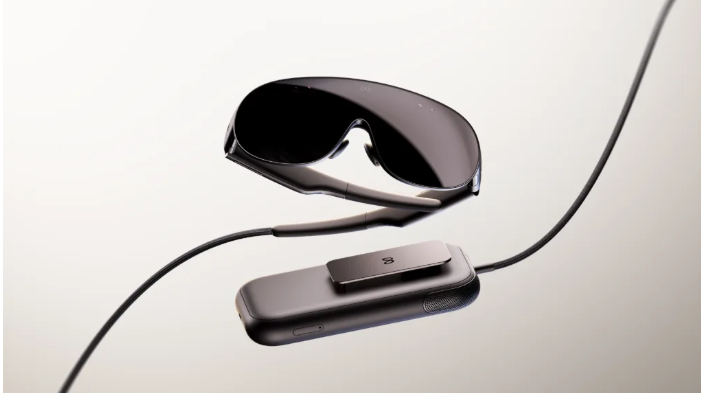
It weighs about 100 grams, five times lighter than a Quest 3.
Look at what Meta chose to call it: Not a headset or another Quest device, glasses.
A device you put on and forget, not one you strap to your head for a session and pull off when you finish.
For teams that use VR to review models and coordinate builds, this is the most important hardware announcement in years.
For a decade, VR has had to overcome the complaint that the hardware is too heavy and awkward to wear for long. Now Meta removed that barrier.
Our customers and our team at Resolve spend a lot of time inside Meta hardware, so we watched the announcement closely. Here is our read on the device Meta will ship, and what it means for the people who use VR to build the physical world.
VR built for work, not just play
The glasses take the straps and the weight off your face by splitting the device in two. The glasses handle the sensors and the display, and a small compute puck carries the processor, the battery, and the storage.
The rumors pointed at a device leaning toward productivity over gaming. The real product leans harder into that than we expected.
The open sides and passthrough camera keep you aware of what is around you. Early hands-on reports call the color passthrough the best yet on a standalone device with no visible stitch lines, low latency, good color, and none of the warped near-field objects that plague past meta headsets.
For anyone who wants to check a model against the space they are standing in, we think this device will make that easier and more natural.
Meta built the glasses as a workspace, too. You get a large private screen, or several, anywhere you are. You can turn any flat surface into a keyboard and touchpad, or connect a Mac or PC and bring your own keyboard and mouse. Full-color passthrough allows you to see your hands, your desk, and your phone while you work.
Controls in your hands (and eyes)
You control the device with your hands and eyes, similar to the Apple Vision Pro. Stare at something with your gaze to highlight it and click your fingers to select. Meta AI is also built into the operating system for voice control. Eye tracking plus natural hand gestures replace the controllers as the default controls out of the box. However, you can pair any Quest touch controllers that you have to the device to use those the same way you would with your Quest 3. They will not ship with the device, however.
Meta VR Glasses specs
The display is a 5K Infinite Display on micro-OLED panels, at 37 pixels per degree. That number means sharp text and crisp detail, which is exactly what you need when you are reading a model or verifying a detail.
The field of view is narrower than the Quest 3, around 70 degrees.
This looks like a deliberate trade off. Meta spent the pixels on sharpness instead of spreading them across your periphery. For gaming, a wide immersive view will usually win. Yet for precision work, we believe the sharpness is a fair exchange for spread. We will want hands-on time to see how 70 degrees feels for full-immersive review.
Under the hood, the glasses run on Qualcomm's new Snapdragon Reality Elite processor, with more compute and more memory (12GB) than the last generation.
This is still a mobile chip, so we don’t expect every type of BIM viewer on the market to see massive gains. But Resolve is tuned to get the most out of the hardware it runs on, so we expect our customers will see noticeable improvement.
Incremental gains in compute and memory translate directly into smoother navigation, larger models, and more detail held on screen.
What this means for construction
Lighter hardware means longer sessions that can turn into real adoption. A device comfortable enough to wear through a full coordination review at a price a company can buy means you can bring in more of the field, the trade partners and the operations stakeholders who catch the expensive problems early.
Lighter, sharper, and built for work is the direction enterprise VR has needed for years and it is now the direction Meta is building. When hardware is this easy to wear, BIM stops being a specialist's screen and becomes a surface the whole team can use in the moments decisions get made.
AI meets wearables
Meta VR Glasses were not the only story at Connect. Meta is pouring investment into the intersection of AI and wearables, from its Ray-Ban glasses to the Meta AI agent built into the operating system of these new glasses. The overall vision is lightweight hardware you wear all day, with an AI assistant riding along, aware of what you see.
For our audience, that is genuinely exciting. A superintendent wearing something no heavier than safety glasses, asking a question about a model out loud and getting an answer in context, hands-free is what we’re building towards. The hardware to make that real is arriving fast, and the gap between the field and the model keeps getting smaller.
Where Resolve fits
We built Resolve for this class of device on purpose. From the start, we built it to render efficiently, hold framerate for the largest models and run across platforms. Resolve works on web, iPad, and VR, giving access to the model no matter where it’s accessed.
The hardware moving toward light, comfortable, and productivity first is the direction we always hoped it would go.
Meta VR Glasses go on sale Spring 2027 at $1,299.99. Spring is a few months further out than some hoped, but it gives the ecosystem, and us, time to be ready on day one.
We cannot wait for you to get your hands on a pair and see how Resolve feels on it.
It's time to build in months, not years.