


A clean clash report means no geometry conflicts. It doesn't mean the space is buildable. Specialty contractor BIM review has always carried that heavier burden, and the question lately is how trade partners are running constructability reviews in a way that gets field judgment into the model before fabrication locks.
TLDR:
- Clash detection misses sequencing gaps and access problems; spatial coordination errors account for 37% of rework causes in one analysis of US construction errors, and rework runs 5-15% of total project cost.
- Specialty contractors own constructability reviews because they hold the most field-accurate model, built from actual purchased equipment.
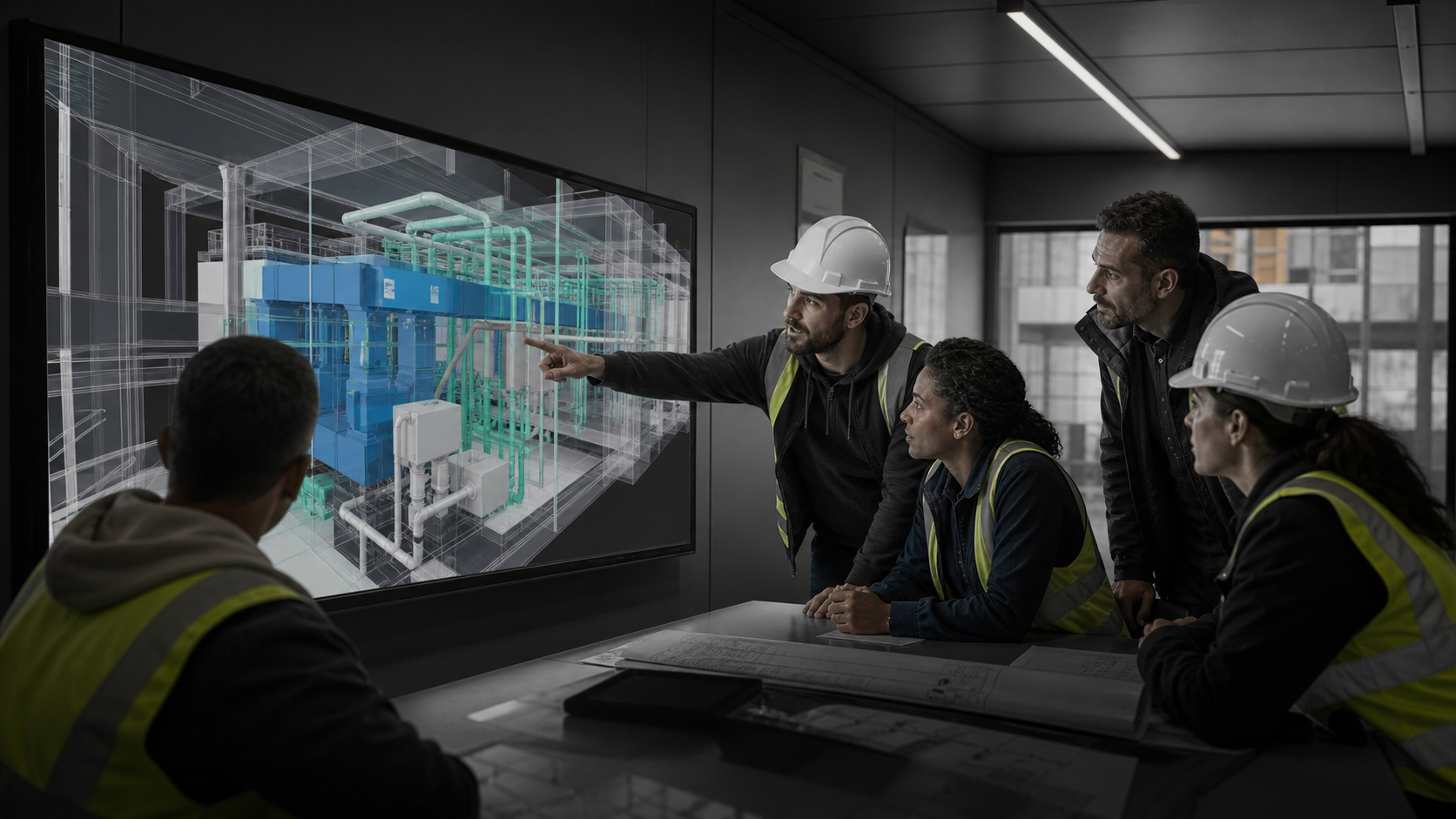
- VR lets superintendents, trade partner VDC coordinators, and facilities staff each move through the model independently, not watch one person drive.
- Run the constructability review after clash detection resolves hard conflicts but before fabrication and procurement lock.
- Resolve connects multi-trade VR reviews to ACC, Procore, and Revizto with two-way issue sync, so annotations from the session push directly into the project log without manual entry.
What a Constructability Review Is
A constructability review is a structured walkthrough of a building model to confirm that what's designed can actually be built, in the right sequence, by the crews doing the work. It goes beyond checking whether systems collide. The questions it answers are different: Can a technician reach that valve once adjacent systems are installed? Is there enough clearance to sequence the ductwork before the structure closes in? Does the mechanical room leave room to actually work?
On complex MEP-heavy projects, mechanical, electrical, plumbing, and fire protection contractors carry most of this responsibility. They redraft design-intent drawings into fabrication-ready models using the exact equipment they'll install, which means they're the first to see where a design works on paper but fails in the field.
Why Specialty Contractors Own the Constructability Problem
Architects and engineers produce design intent. On a data center or hospital, that means routing paths, approximate equipment footprints, and system layouts that are correct in principle but not yet buildable. Specialty contractors take those drawings and rebuild them using actual purchased equipment: specific chiller models, real conduit sizes, exact VAV box dimensions from submitted shop drawings.
That redesign step reintroduces conflicts the original model never had. A duct run moves 8 inches to accommodate a manufacturer's actual housing and suddenly threads through a structural bay that barely fit before. The mechanical contractor sees it. Nobody else does yet.
This is why specialty contractor BIM coordination belongs to specialty contractors. They hold the most current, field-accurate version of the model. They know where sequences get tight, where access gets difficult, and where fabrication constraints will bite. A GC can flag gross clashes, but sequencing judgment lives inside the trade partner's head and their model.
What Clash Detection Misses and Why It Matters
Clash detection answers one question: do two objects occupy the same space? A clean report means no intersections. It says nothing about whether a technician can reach equipment once the ceiling grid is in, whether a corridor that meets code on paper is passable at human scale, or whether a ductwork sequence requires installing something before the structure that supports it is closed.
Research on BIM-based coordination found that 28% of design issues remained unresolved by the end of the design coordination stage, many involving sequencing, clearance, and access problems that automated clash detection never flags (Mehrbod et al., ITcon, 2019).
Human-scale judgment is what closes that gap.
How VR Changes the Constructability Review
Standing inside a model changes what you see. A duct run that looks fine on a monitor reads completely differently when you're standing next to it at human scale and the adjacent pipe reduces working clearance to inches.
There are a few specific capabilities that make this work in practice.
- Free locomotion and teleportation let a reviewer move through the space the way a crew would: walking corridors, stepping into mechanical rooms, crouching into ceiling cavities, catching what clash detection in construction BIM alone would miss.
- X-ray mode lets them see what's behind a wall or above a ceiling without leaving the space.
- A measurement tool confirms whether a gap is workable or just looks that way from a distance.
The result is a pre-construction site walk through a model that's still fully editable. Issues that would show up on day three of installation can surface before fabrication starts.
The BIM Coordination Workflow for Specialty Contractors
Specialty contractors follow a coordination sequence that runs from model production through sign-off, and the constructability review sits at a specific point in that chain.
The sequence runs roughly like this:
- Receive design-intent documents and produce discipline-specific fabrication models using actual purchased equipment
- Federate individual trade models into a combined set alongside structural, architectural, and other systems
- Run clash detection to resolve hard geometry conflicts between disciplines
- Conduct a constructability review on the clash-resolved model before fabrication and procurement lock
That last step is where VR earns its place. Once hard clashes are resolved, the model looks clean on paper. But constructability questions, sequencing order, access clearances, and working room around equipment are still open. Fabrication commitments made before those questions are answered generate field surprises.
The MCAA, NECA, and SMACNA jointly published MCAA spatial coordination guide for specialty contractors that formalizes this workflow, recognizing that the coordination burden on trade partners goes well beyond running a clash report. The review phase is where field judgment finally meets the model, and it has to happen while the design can still move.
Who Needs to Be in the Review
Specialty contractor BIM reviews break down when only the VDC team shows up. The model gets checked for geometry and nothing else. The people who would catch a sequencing conflict or a maintenance access problem are watching from the hallway.
Three groups need to be in the review:
| Reviewer | What They Bring | What They Catch |
|---|---|---|
| Superintendents and foremen | Field knowledge of how crews work in a space | Corridors that are code-compliant on paper but not buildable in practice; sequencing conflicts crews would hit on day one |
| Trade partner VDC coordinators | Ownership of discipline models and fabrication constraints behind every routing decision | Clashes reintroduced by actual equipment dimensions; routing changes that affect adjacent trades |
| Owner facilities staff | Long-term responsibility for maintaining equipment after handover | Access problems around equipment before ceilings and finishes close permanently |
The obstacle with the second and third groups is engagement. A foreman handed a laptop with a federated model loaded in Navisworks rarely gives useful feedback. The interface is unfamiliar, navigation requires a specialist, and the review ends with one VDC coordinator driving while everyone else watches passively.
VR changes how participation works. Each reviewer moves through the space independently, flagging what they see. A facilities manager can check clearance around a chiller without waiting for a coordinator to move there. A superintendent can walk the mechanical room sequence without interrupting anyone.
How Multi-Trade Coordination Reviews Work in Practice
When multiple trades share a federated model, the coordination problem layers fast. A mechanical contractor's routing fix can open a conflict with electrical, a reminder of how tightly the MEP coordination process links trades together. An electrical decision affects fire protection downstream. Each trade carries its own model, its own priorities, and its own foreman who may have never seen another discipline's system up close, which is where a BIM collaboration and coordination breakdown starts.
A multi-trade VR session puts everyone in the same model at once. The mechanical coordinator walks the ceiling space in a headset. The electrical VDC lead follows from a browser. The fire protection super joins on an iPad. No downloads, licenses, or training required for the web or iPad participants.
A reviewer in the headset flags a clearance problem, marks an annotation, and every other participant sees it in context. No screenshot chain. The annotation syncs directly to ACC or Procore, tying BIM coordination and clash detection so the issue log updates without a separate entry, tied to the exact location in the model.
Issue Logging and Closing the Loop
A constructability review that produces no tracked output is just a conversation. The value is in what gets logged, assigned, and resolved before fabrication locks.
When a reviewer flags an issue inside a VR session, that annotation ties to a specific location in the model. It syncs directly to ACC, Procore, or Revizto without a manual entry step. No screenshot, no separate ticket, no copy-paste. The issue appears in the project log with the session author, the annotation text, and a cross-reference back to the model coordinate.
Two-way sync means status changes flow both directions. If the mechanical coordinator marks an issue resolved in ACC, it closes in Resolve. If it gets flagged again, that update comes back too. No merging two separate logs at the end of the week.
For multi-trade reviews, traceability goes beyond convenience. When a clearance conflict is flagged and the responsible trade closes it, there's a record of who resolved it, when, and against which model version. On a data center or hospital, a missed item has real consequences after installation.
VR Constructability Reviews in High-Stakes Project Types
On a data center build, one of the large project BIM coordination best practices is catching a coordination miss near live electrical infrastructure before it carries arc flash risk. On a pharmaceutical project, rework inside a certified clean room triggers full re-sterilization before work can continue. On a hospital, MEP systems routed above patient ceilings have no margin for an access gap found after the ceiling grid closes.
These project types change the cost of skipping a constructability review, not the mechanics of running one.
Specialty contractors here run reviews more frequently and at finer scope. A mechanical contractor on a data center might walk an electrical room corridor across multiple model iterations, checking clearance as equipment submittals refine the actual footprint. A pharmaceutical trade partner will flag access to any valve or disconnect sitting behind another system before clean room certification starts, because fixing it after costs far more than the review session did.
The stakes also change who participates. Facilities staff and owner safety personnel show up because they bear the long-term consequences. A facilities manager walking the model before construction closes catches the maintenance access problem that would otherwise surface two years into operations as a service disruption.
Common Objections from Specialty Contractors
Three objections come up consistently.
Field staff unfamiliarity with headsets is real. A foreman who fumbles a controller in front of the team is unlikely to use VR again. The fix is a short solo orientation before any group session, not a full training program.
Model performance on standalone wireless hardware is a legitimate concern with large federated models. Frame rate instability causes motion sickness, which sets back adoption faster than any budget conversation. Verify the model runs smoothly on the target headset before a full team review.
Skepticism that findings will influence GC decisions is harder to dismiss. If previous feedback from specialty contractors disappeared into a comment log nobody read, that skepticism is earned. That's why VR coordination reviews need a clear path to resolution built in. VR review only delivers value when issues logged during the session have a clear owner, a real path to resolution, and status tracked in the same system the GC's coordination team already uses.
How Resolve Supports Specialty Contractor BIM Reviews
Resolve runs multi-trade constructability reviews across wireless Meta Quest headsets, web browsers, and iPads simultaneously. No downloads. No BIM training required for superintendents, facilities staff, or owners joining from a browser or tablet.
The Wellington Engine loads full federated models on standalone wireless headsets without downsizing or model-cutting. On geometry-heavy builds like hyperscale data centers, that matters: frame rate instability causes motion sickness, and a session that makes a foreman nauseous ends adoption faster than any cost objection.
Two-way issue sync connects reviews to ACC, Procore, and Revizto so annotations created in the session push directly into the project issue log. Status changes in those systems flow back into Resolve. No separate entry, no reconciliation.
AI Spatial Assist lets any participant query the model in plain language. A facilities manager can ask where a specific air handler is and move directly to it without waiting for a VDC coordinator to drive. That distributes the review across participants who actually have field judgment.
Resolve was the first VR integration for Autodesk BIM 360, a distinction worth weighing when considering how Resolve compares to other coordination tools. For specialty contractors already working inside ACC or Procore, the model links directly from the CDE. Set it up once; it stays current as models update.
BIM Coordination and Constructability for Specialty Contractors
The model looks clean after clash detection. That's the moment the real constructability questions start. Your crews know things the geometry report can't tell you, and getting that knowledge into the model before fabrication locks is what separates a smooth install from a field surprise. Running that review while the design can still move is the whole point.
Request a demo to see how specialty contractors run constructability reviews in Resolve.
FAQ
How do specialty contractors catch constructability issues that BIM clash detection misses?
Clash detection confirms that two objects don't occupy the same space. It cannot flag whether a technician can physically reach a valve once adjacent systems are installed, whether a corridor that meets code on paper is passable at human scale, or whether a ductwork sequence requires installing components before supporting structure closes in. Specialty contractors close that gap by running a constructability review on the clash-resolved model before fabrication locks, using human-scale spatial judgment to surface sequencing, access, and working-clearance problems that pass every automated check.
How can superintendents and facilities staff review a BIM model without CAD training?
A superintendent or facilities manager does not need CAD experience to give useful feedback in a constructability review. In Resolve, web and iPad participants join from a shared link with no download, no account, and no training required; a headset user can move through the same federated model simultaneously. That means a foreman can walk a mechanical room sequence and a facilities manager can check chiller clearance independently, without waiting for a VDC coordinator to drive the session.
What should a specialty contractor BIM review include beyond clash detection?
A specialty contractor constructability review should cover sequencing order, equipment access clearances, maintenance working room, and installation feasibility using fabrication-ready models built from actual confirmed equipment. Running it after clash detection but before fabrication commitments is the window where findings are still cheap to act on; issues found after installation lock carry rework costs that run 5 to 15 percent of total project cost.
Trade partner constructability VR vs. screen-share review: which surfaces more field issues?
VR surfaces a different class of issues. A duct run that looks acceptable on a monitor reads differently when a superintendent is standing next to it at human scale and the adjacent pipe reduces working clearance to a few inches. Screen-share reviews keep one VDC coordinator in control of the camera while everyone else watches; VR lets each participant move through the space independently and flag what they see, which is how field judgment from foremen and facilities staff actually enters the coordination record.
How does Resolve connect a specialty contractor constructability review to the project issue log?
Annotations created during a Resolve session sync directly to Autodesk Construction Cloud, Procore, or Revizto without a manual entry step. The issue lands in the project log with the session author, annotation text, and the exact model coordinate attached. Two-way sync means status changes in those systems flow back into Resolve, so specialty contractor teams and GC coordinators work from one record instead of merging separate logs at the end of the week.
It's time to build in months, not years.