

Getting the right people into a hospital model before construction locks in the design is a completely different challenge from a standard commercial build. A missed clearance can mean a stretcher can't pass or a technician can't reach a valve in an emergency, and rework in a sterile environment costs far more than a change order. So if you're weighing your options for immersive BIM review in healthcare, here's what holds up under that kind of pressure.
TLDR:
- Good healthcare BIM review tools must run full federated MEP models, support non-specialists, and connect to ACC, Procore, and Revizto.
- SENTIO VR targets design presentations and lacks construction-side integrations for federated hospital coordination.
- Autodesk Workshop XR and Vrex both have unclear development status based on publicly available information.
- Resolve runs full hospital MEP models on standalone VR headsets and syncs issues across VR, web, and iPad without requiring BIM training.
Immersive BIM Review in Healthcare Construction
Hospital construction carries almost no margin for guesswork. Behind every ceiling tile sits a dense layer of medical gas lines, electrical conduit, and mechanical ductwork, all coordinated around BIM clash detection and clearances that patient safety depends on. Healthcare facilities impose specific MEP clearance requirements around equipment, minimum ceiling heights in patient areas, and segregated medical gas zones that go well beyond a typical commercial build. Immersive BIM VR review means walking through that model at full scale before anything gets built, so the people who know the space best can catch what a flat screen hides.

The stakes are different than a typical commercial build. A missed clearance in an office building means a change order. In a hospital corridor, it can mean a stretcher cannot pass or a technician cannot reach a shutoff valve during an emergency. Sterile environments raise the cost of rework even further once a space has been finished and cleaned, which makes BIM VR ROI for construction teams especially high.
A tool built for this setting needs to handle large, federated MEP models without downsizing them, and it needs to work for superintendents, facilities managers, and clinicians who have never opened Navisworks. Healthcare BIM review is a coordination step, not a visualization exercise, that brings field and clinical judgment into the model while the design can still change.
Ranking Criteria
We reviewed each tool against the demands of hospital projects, not generic BIM review needs. Six criteria mattered most.
- Model handling at scale: can it run full federated MEP models without downsizing geometry or stripping detail first
- Non-specialist BIM access: can a facilities manager, nurse, or clinician use it without BIM training
- BIM viewer across web, iPad, and VR: does it work across VR headset, web browser, and iPad so trade partners without headsets can still participate
- Construction-side integrations: does it connect to Autodesk ACC, Procore, and Revizto so issues sync back to the tools coordination teams already use
- Active development: is the tool still receiving updates, or has it been sunset or left stagnant
- Real-time multi-user collaboration: can a superintendent in BIM virtual reality, a trade partner on web, and a facilities lead on iPad all review the same model at the same time
We drew on public product documentation, marketplace listings, and app store information for each tool. No tool was tested internally for this comparison. Where development status is unclear, we note that directly instead of guessing.
Resolve: Best Overall for Healthcare
Resolve leads this category because it solves the two problems every hospital project runs into: models too heavy to move, and reviewers who never touched Revit.
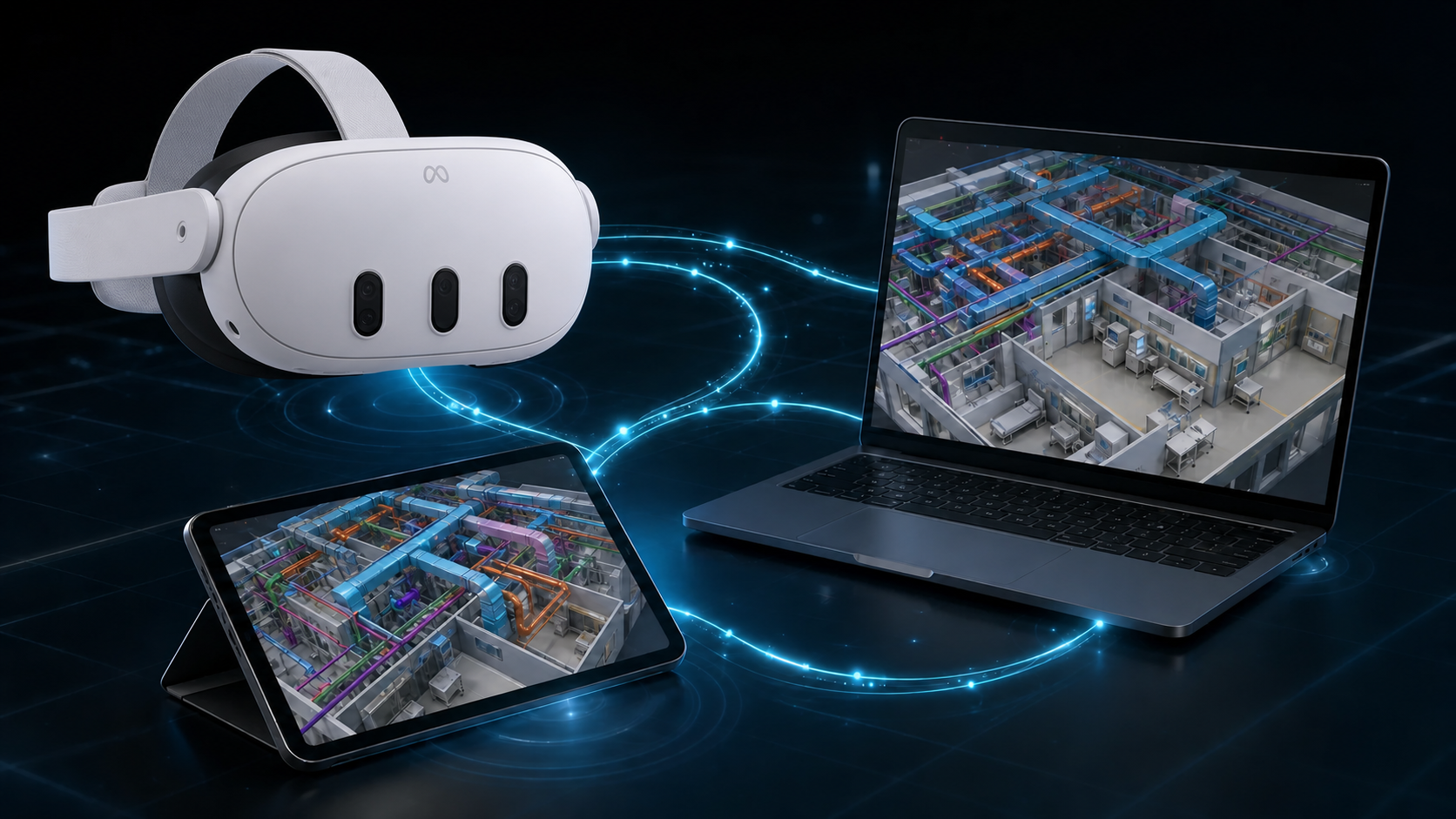
The Wellington Engine, Resolve's proprietary model processing system, runs full federated hospital models on wireless standalone Meta Quest headsets. No gaming PC, no tether, no stripped-down mockup of the real design. A facilities manager can review the same MEP-dense model the coordination team built, at full scale, using real-time multi-user collaboration without BIM training or a managed device. Trade partners and superintendents join the same session from a web browser or iPad. Issues created during that review sync back to ACC, Procore, and Revizto, so nothing lives in a disconnected side workflow.
Autodesk Workshop XR
Autodesk Workshop XR is the successor to IrisVR Prospect, which was acquired by The Wild and eventually folded into the Autodesk product line. It is marketed primarily to engineers and designers already working inside Autodesk's authoring ecosystem, particularly Revit users. Based on publicly available documentation, its end-of-life is reportedly September 2026, and it has not published release notes recently, making its current development direction unclear. Teams weighing it for hospital coordination should factor the roadmap uncertainty into any workflow decision that depends on ongoing updates.
What They Offer
- VR model review tied to Autodesk's authoring ecosystem, particularly Revit
- Design and engineering-side review workflows for teams already inside Autodesk Construction Cloud
- Spatial walkthroughs aimed at engineers and designers reviewing design intent
Good for: engineering and design teams already embedded in the Autodesk ecosystem who need an accessible entry point into immersive review without leaving that environment.
Limitation: Workshop XR is positioned toward the authoring and design side, not the construction coordination side. For GC-led hospital projects involving trade partners, non-specialist facilities staff, and dense federated MEP models, the tool's orientation and unclear development status both raise practical concerns.
Bottom line: teams running active hospital MEP coordination across a GC, trade partners, and facilities reviewers need a tool with a confirmed roadmap and construction-side integrations.
SENTIO VR
SENTIO VR bills itself as a cloud-based immersive tool for design presentations, with integrations built for Revit, SketchUp, Enscape, and Lumion. G2 describes it as a tool "to review designs, manage client presentations and collaborate for professionals working in the Building Industry," pointing to an architecture-first audience, not a construction coordination one.
What They Offer
- Cloud-based VR model viewing tied to Revit, SketchUp, Enscape, and Lumion
- Design presentation and client review workflows
- Immersive walkthroughs aimed at design-side stakeholders
Good for: architecture and interior design firms needing an accessible VR tool for early client-facing design reviews.
Limitation: there is no sign of integration with Procore, Revizto, or ACC for issue tracking, and nothing in its documentation suggests it can carry the large federated multi-discipline models a hospital MEP coordination effort produces.
Bottom line: healthcare teams coordinating federated models across a GC, trade partners, and facilities staff need a tool built for constructability review in VR and that heavier workload.
Sources
Vrex
Vrex is a Nordic VR-for-BIM tool built for power users and technically fluent teams. Based on publicly available information, it is more desktop-based than standalone-headset-first, which affects how accessible it is to non-specialist reviewers. Its Capterra listing shows no user reviews, and its website has been unreachable during recent research, making it difficult to confirm current development status or active feature support.
What They Offer
- VR model review aimed at technically proficient BIM and VDC users
- Desktop-based workflow requiring more technical setup than standalone headset solutions
- Nordic market origins with limited public documentation on current integrations or support
Good for: technically experienced VDC teams comfortable with a desktop-dependent workflow and willing to work with a tool whose current status is difficult to verify.
Limitation: the desktop-first orientation raises a barrier for the non-specialist stakeholders, such as facilities managers, nurses, and superintendents, that hospital coordination most depends on. With no confirmed integration with ACC, Procore, or Revizto, and unclear development activity, teams need to do thorough due diligence before building a coordination workflow around it.
Bottom line: for hospital projects that require cross-platform access across VR, web, and iPad, two-way issue sync with construction software, and a tool non-specialists can actually use, Vrex does not provide the evidence needed to assess it confidently against those requirements.
Feature Comparison
A few rows carry caveats worth stating plainly. Vrex's multi-user support and development status are marked unclear because its site has been unreachable during recent research, and its Capterra listing shows no reviews to draw from. Autodesk Workshop XR has not published release notes recently, so we list its status as unclear instead of guessing at momentum either direction.
| Criteria | Resolve | Autodesk Workshop XR | SENTIO VR | Vrex |
|---|---|---|---|---|
| Full federated MEP model support (no downsizing) | Yes | Partial (design-side focus) | No | Unclear |
| Non-specialist access (no BIM training required) | Yes | No (Revit/authoring-user focus) | Limited (design presentations) | No (technically proficient users) |
| Standalone wireless VR headset support | Yes (Meta Quest) | Yes | Yes | No (desktop-based) |
| Cross-platform: VR + web + iPad | Yes | Limited | Limited | Unclear |
| ACC / Procore / Revizto issue sync | Yes (two-way) | ACC only | No | Unclear |
| Real-time multi-user collaboration | Yes | Limited | Yes | Unclear |
| Active development status | Active | Unclear (EOL reportedly Sept 2026) | Active | Unclear (site unreachable) |
| Primary use case | Construction coordination | Design / authoring review | Design presentations | VDC / power users |
Resolve is the only tool here built to move a hospital MEP model across VR, web, and iPad, sync issues both ways with the construction software teams already run, and hand non-specialists a way in without a headset or training. The other three tools each cover a slice of that list. None cover the whole thing.
Why Resolve Leads for Healthcare
Hospital projects expose every gap a BIM review tool has. Models are dense, stakeholders range from VDC engineers to nurses who have never opened Navisworks, and the cost of a missed clearance compounds fast once a sterile environment is finished. Resolve is built for exactly that combination. The Wellington Engine runs full federated MEP models on wireless standalone Quest headsets without downsizing geometry or stripping out detail, so a facilities manager or clinician sees the same model the coordination team built. Trade partners and superintendents join the same session from a web browser or iPad, with no download, no training, and no managed device required. Issues flagged during that review sync back to ACC, Procore, and Revizto, keeping hospital coordination connected to the tools the GC and trade partners already run. For healthcare teams, that means the people who know what a space has to do at full scale can shape decisions before the building exists, before rework is expensive, and before sterile environments make changes nearly impossible to act on.
Final Thoughts
Healthcare projects demand more from a BIM review tool than most comparisons account for. Your coordination team, trade partners, and facilities staff all need access to the same model, and the tool carrying that model has to hold up under real hospital MEP density. The four tools above show how different that range of capability can be. Resolve offers a free trial if you want to bring your own model in and see how it runs.
FAQ
How do I choose the right immersive BIM review tool for a hospital project?
Start with model scale and stakeholder mix. If your project involves large federated MEP models and reviewers who have never opened Navisworks, including facilities managers, nurses, or clinicians, you need a tool built to handle that weight without downsizing geometry and that works across VR, web, and iPad without requiring BIM training. Then confirm it syncs issues back to the construction software your coordination team already runs.
Is Resolve better than Autodesk Workshop XR for healthcare MEP coordination?
For teams coordinating dense federated hospital models across a GC, trade partners, and non-specialist facilities staff, Resolve is the stronger fit. Workshop XR is marketed toward engineers and designers working closer to authoring tools like Revit. Resolve is built for the construction side, with cross-platform access across VR, web, and iPad, and two-way issue sync with ACC, Procore, and Revizto.
Is SENTIO VR a viable option for hospital construction coordination?
SENTIO VR targets design presentations; it lacks ACC, Procore, and Revizto integrations needed for hospital MEP coordination. It has no documented integration with Procore, Revizto, or ACC for issue tracking, and nothing in its documentation suggests it can carry the large federated multi-discipline models a hospital MEP coordination effort produces. Teams running active coordination workflows need a tool built for that workload.
When should a hospital project team bring immersive BIM review into the workflow?
The highest-value window is pre-construction, when trade partners have redrawn design-intent models using actual manufacturer equipment and new coordination risks have been introduced. Getting facilities managers, superintendents, and clinicians into the model at that stage, before designs are locked and rework is expensive, is where immersive review changes delivery outcomes. Sterile environments make late-stage rework especially costly, which raises the stakes for catching issues early.
Can non-BIM users like nurses and facilities managers participate in a Resolve review without technical training?
Yes. Resolve is built so non-specialists can step through a full federated model on a wireless Meta Quest headset, a web browser, or an iPad without BIM training or a managed device. That access is what makes clinical and facilities input possible during coordination, before the building exists and before their feedback costs anything to act on.
It's time to build in months, not years.